Advanced Telescope Supplies
Australia's Premier CCD and Astro-Imaging Experts
Why Buy an SBIG CCD Imager from ATS?
Advanced Telescope Supplies has been in association with SBIG for over 25 years and not surprisingly we have gotten to know a little bit about their products in that time.
- Our pricing is equivalent to importing directly from the USA
- You have added advantages of a 240V Australian modified power supplies.
- A local Australian 24 month warranty and support.
- We also locally perform factory approved camera service & modifications,
- If you have a problem we save you the time and expense of an expensive shipping return to the USA.
We provide expert local support on all SBIG cameras and software
Still thinking about buying directly from the USA via the Internet? please fax or e-mail us your best quote (From an authorised SBIG dealer, yes even one in the USA). We will try to match or better it to get your business!
Also here is SBIG's Official policy on cameras purchased direct from the USA
The new TWO year warranty on all SBIG products (*excluding CCD chips which are one year) applies only to products sold through authorized dealers in countries where we have exclusive arrangements (e.g. Australia). Any US dealer selling to one of these countries is now obliged to inform the customer that there is no warranty on the camera and warranty repairs, if required, will be at the selling dealer's expense, including shipping.
Choosing a CCD imager can be a difficult task. It also has to be said there is a lot of conflicting information out there on "which is the best" CCD for a particular telescope. Also many amateurs have a problem with an accessory that costs as much, if not more than their entire telescope. SBIG make a range of CCD cameras that suit many needs and budgets. Hallmarks of the SBIG range are:
- Ease of use
- Reliable and versatile bundled software
- Extensive accessory range
- Award winning image quality
- Excellent after market support
With their high dynamic ranges and quantum efficiencies, CCD cameras are changing the way many astronomers capture images and data from the night sky.
A modest six inch aperture telescope equipped with a CCD camera will detect fainter objects than a 36" telescope with a standard photographic camera!
Put that way, paying for an accessory that improves the detection ability of telescope by a factor of more than 30x is perhaps well worth the cost of the telescope itself!
Please call or e-mail us, or see SBIG's home page for more information about other SBIG camera models. Our $A prices are approximately SBIG's $US list converted to $A (TravelEx $US buy rate) plus 15% to cover GST and shipping.
Digital Imaging choices.
Astronomy CCD manufacturers have pioneered many technologies that have been fine tuned for astronomical imaging and research for close to 20 years. But for many telescope users, the benefits of these features may not be obvious or hard to justify on a cost only basis.
Comparatively recent digital SLR technology is improving from year to year, and as their cost base falls along with improving performance, there is no doubt that using these cameras for astronomical imaging can give good results.
While absolute image quality remains clearly superior with dedicated CCD systems, if picture taking is your only goal, reasonable astro-images can be obtained obtained by stacking dozens of exposures taken with DSLR's.
There are some hidden costs with DSLR astro-imaging which should be factored in the cost of imaging system eg:
- autoguider or guiding eyepiece
- guide-telescope or
- off axis guider
- guide telescope mounting rings/mounting system
- balance system for SCT fork mountings
It should be noted CCD imagers, as opposed to a "camera" have other functions, features and options that are simply not present an never likely to be implemented with DSLR's
- High QE CCD rather than CMOS based sensors
- A large choice of monochrome or colour sensors
- Higher resolution (no Bayer matrix)
- Double stage peltier or water cooling options or both
- Track and accumulate technology
- Autoguiding, self guiding or both
- Photometry
- Spectroscopy
- Adaptive optics
- TDI (time delay integration) imaging modes
When considering a digital imaging system some factors will be more important to some, and less so to others. We hope that the information provided here will help with your decision making.
|
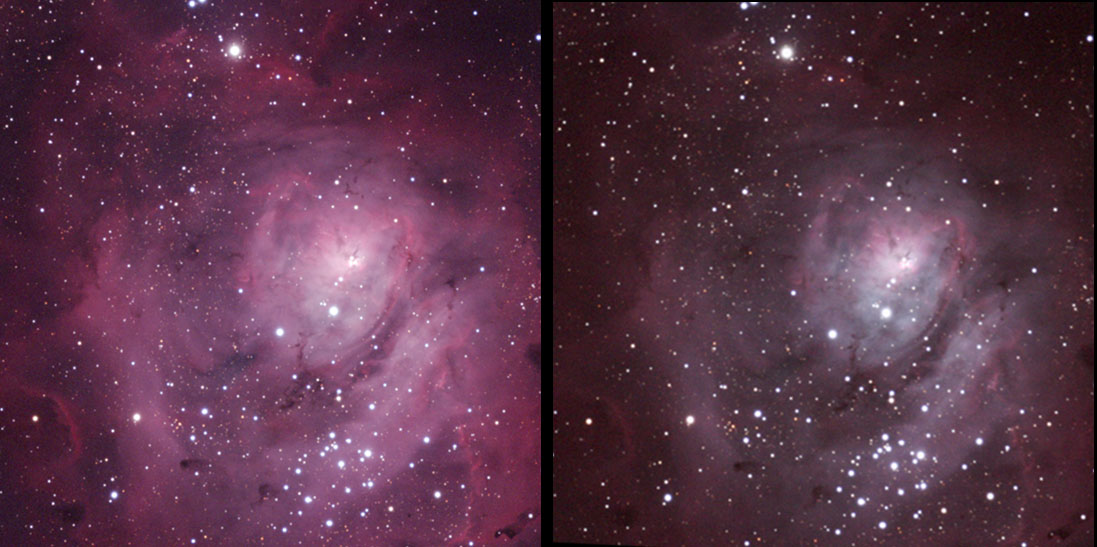
Below: CCD image of M8 (left ) compared to a Canon 350D DSLR image (right) taken through the same telescope. |
|
|
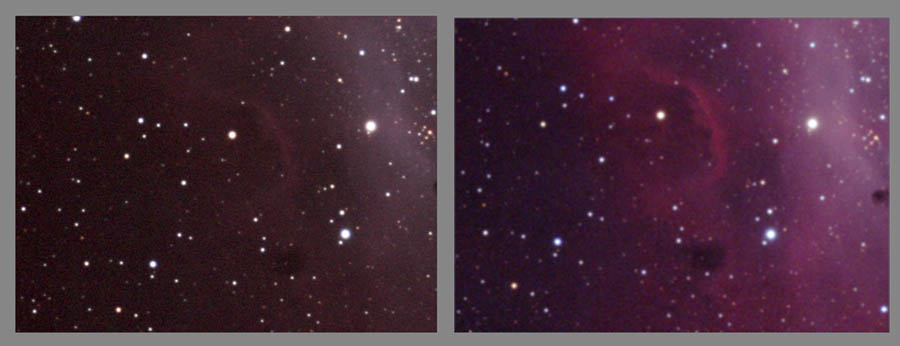 |
Despite a short exposure time, the superior sensitivity of a CCD (at right) becomes very obvious with nebulosity (H-Alpha) and faint objects. |
The images shown above demonstrate how current model "real world" performance varies with each camera on relatively bright astronomical objects. Both image used the same F-ratio and were taken within a few minutes of each other on the same night.
- The CCD (SBIG ST2000xm +CFW) image was taken using 2 minutes exposure in red, green and blue light. (total exposure 6 minutes)
- The Canon 350D image is a sum of three 2 minute exposures, again a total exposure time of 6 minutes.
- Only grey scale (gamma) correction was applied to each image. No other processing (eg unsharp-masking) was performed.
- The Canon 350D image was guided with the same auto-guide head used for the CCD image
The images are comparable in some ways, but very different in others. To comment further, the dedicated astro-imaging CCD camera clearly has
- Higher overall sensitivity (QE)
- Higher sensitivity in H-alpha
- Greater dynamic range
- Significantly lower noise
- Superior faint object detail
In terms of cost, CCD there is no hiding the fact that systems are more expensive, and likely to remain so due to the specialist nature of their design and inclusions
Each STT SBIG camera system INCLUDES:
• Ethernet and USB 2.0
• Built-in Web Server
• Full Frame Image Buffer
• 2-Stage TE Cooling > -50C delta T with air
• Liquid Cooling Capability Standard for greater cooling
• Twin Variable Speed Fans
• High Accuracy Temperature Control
• Built-in Frost Detection
• Built-in RBI Pre-flash
• External Triggers In / Out
• Power Management System
• 12VDC Operation
• Lowest Noise 10Mhz Readout (<1 sec download)
• High Precision 8-position Filter Wheel Option
• Accepts 1.25", 31mm and 3mm filters
• Even-illumination (photometric) shutter
• Multi-coated Sapphire Chamber Window
• Optional Self-Guiding in Front of filters
• Optional Remote Guide Head
• Optional Adaptive Optics (AO-8T)
• User Rechargeable Desiccant Plug
• User Selectable Internal Image Processing
• Status, Power and Relay Indicators
• Windows and Mac Control Software, 32 and 64 bit
Our tests have shown by increasing the DSLR exposure time by approximately a factor of 4x. image quality becomes comparable to the dedicated CCD, but not with faint objects (e.g. galaxies) as this relationship is no longer valid. The intrinsic noise in the DSLR then begins to dominate over very faint objects, and requires exposure 32x to 64x times that, yet still remain camera noise limited for very faint objects.
Increasing the CCD exposure times by a factor of 4x that above results in a significant image density improvement as well, but more importantly, the noise in the image still remains very low when longer exposures are taken.
SBIG CCD features.
Autoguiding and self guiding
All SBIG CCD cameras can be used as auto-guiders. The native auto-guiding algorithm used by SBIG (hardwired in the model ST4 ansd STV’s and with every copy of CCDOPS) is so accurate any reliable that it has been in use in stand alone auto-guiding systems for nearly 20 years, and has been used to guide instruments such as the UK Schmidt Telescope.
Telescope aberrations aside, perfectly guided star images are a hallmark of SBIG dual CCD cameras.
With monochrome SBIG cameras the guide CCD does sit behind the filter wheel assembly, however finding a suitable guide star is rarely a problem, as the guide CCD is extremely sensitive and the camera head can positioned at any angle for guide star acquisition.
No other camera manufacturer offers as many guiding options as SBIG. Unattenuated guiding via Self Guide filter wheels and remote guide heads plus adaptive optics.
Science Applications
SBIG have a range of integrated accessiories and filter sets that are unmatched by any other manufacturer. These include up to 8 position filterwheels, adaptive optics and spectrographs. Integration is seamless, no other parts or software are required for their operation.
In addition SBIG CCD chamber cooling is extremely repeatable and accurate. As a result image data that can be calibrated to a very high precision allowing photometry to 1/1000th of a magnitude using SBIG’s MILLIMAG or third party software.
Sensor sensitivity and resolution.
Nearly all of the SBIG camera range is based upon full frame monochrome Kodak sensors. These have consistently higher peak quantum efficiencies compared all interline devices. and single shot colour devices.
Kodak full frame sensors have a range of pixel sizes (from 6.8 to 24 micron) and while rival manufactures may claim higher resolutions based on 6.4 micron technology.
This is false.
These devices are Bayer matrix based based, hence the first adjacent pixel that is capable of sensing light without being interpolated is 6.4 micron away, hence pixels have approximately a minimum 12.8 micron width not 6.4. Bayer matrix based (single shot colour) cameras use a interpolative method to estimate the colour of adjacent pixels, which does not always work well with point like source data (eg Stars) often resultion in fine colour fringes around high contrast points.
The same is not true with full fame devices. Each and every pixel is used to capture incoming light.
Santa Barbara Instrument Group
(SBIG) STT series CCD cameras
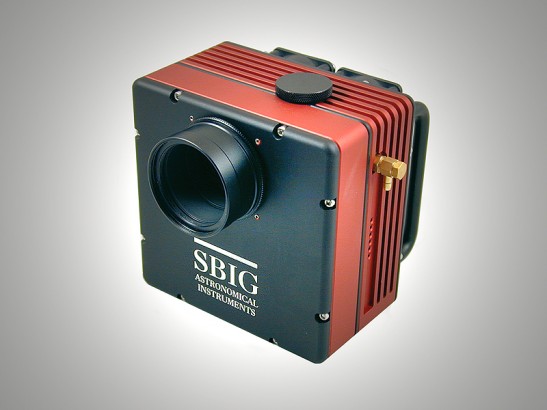
Micron-Precision Filter Wheel / Guider
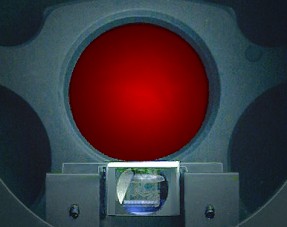
The filter wheel design for the STT series sets it apart. The carousel holds eight 36mm filters and inserts are available for 1.25" filters. Two new unique features make this an imager's delight: First, the design incorporates a self-guiding CCD in the filter wheel cover so that light from the guide star is captured before passing through the filters. An optional filter wheel cover is available for wide angle imaging with Nikon or Canon 35mm camera lenses, or for anyone who does not need or want the built-in self-guiding. Full sets of 36mm LRGB and Narrowband filters are available for unvignetted imaging at any f/ratio. The second unique feature of the STT filter wheel is a positive centering mechanism that precisely re-positions and firmly holds filters in exactly the same position over the CCD every time, regardless of a loss of power or intervening movement of the filter wheel.
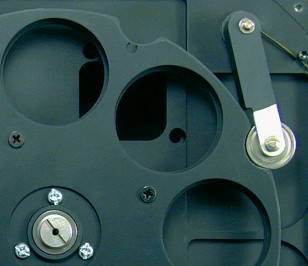
In our tests of the new design, using an STT-8300, the re-positioning of the filters was accurate to better than 5.4 microns after several complete rotations of the filter carousel. This degree of precision means that flat fields taken after the filter has moved and returned are accurate to a single pixel. An example of the improvement in flat fields with this kind of precision is demonstrated in the comparison images below.
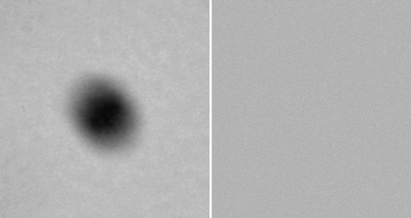
The image at left, above, is a large opaque spot on a filter in STT filter wheel. The filter carousel was rotated several times before the filter was moved back into the optical path and a flat field was taken. The image at right shows the resulting flat field image.
Even-Illumination Shutter
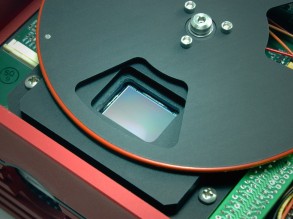
A mechanical shutter is included to facilitate dark frames. This is a necessity for anyone operating remotely; even if remotely means a few feet away from the telescope. Since the early days of the original ST-7 camera, SBIG has been providing even-illumination shutters in our cameras, something not found in the majority of other cameras made for astrophotography. "Even-illumination" means that the shutter mechanism is designed to open and close in such a manner that it does not change the proportion of light falling on the sensor due to the shape or motion of the shutter itself. This is what one finds for instance with an iris type of shutter that opens-up starting at the center and closes over the center last. In the STT-8300 we use a simple and very robust shutter wheel with a fan-shaped aperture of the same design that we have employed in the ST series cameras for the past 15 years. The STT-8300 shutter sweeps over the CCD without leaving any area of the sensor exposed for a different period of time than any other area. Another benefit of the rotating disk type of shutter is that it has only one moving part - the motor. These motors are extremely reliable and can operate for millions of exposures without failure. In 15 years with thousands of cameras in the field taking millions of exposures, this shutter design has proven itself better than we can describe. Our design is accurate, proven and reliable. Even-illumination shutters are also referred to as photometric shutters because they produce flat frames of photometric quality. This is extremely important when taking twilight flats or any flat field image using short exposure times. The effect is demonstrated in the twilight flat field images shown below:
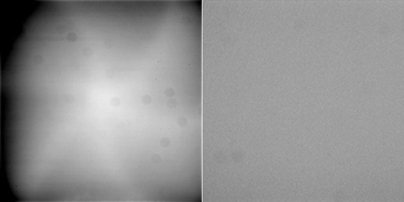
The left image shows a twilight flat field image taken with a camera using an iris type shutter. The right image is a flat field image taken under the same conditions using our even-illumination type shutter.
Efficient 2-Stage TE cooling
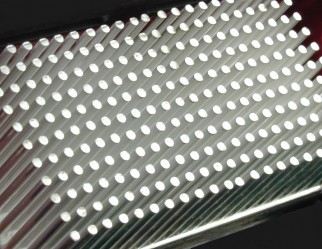
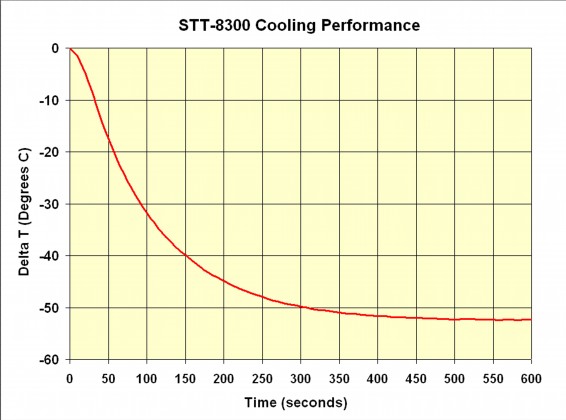
The STT uses two-stage TE cooling, twin variable-speed fans and a highly efficient pin fin array heat sink that has proven itself in the STX design. Pin fin heat sinks are more expensive than typical parallel fin type heat sinks, but offer more efficient heat dissipation in a given space. In our tests of prototype models, the cameras reached an average delta greater than -50C in five minutes and an average maximum delta of -57C in less than 10 minutes using air cooling only. And, while is should not be necessary to use water cooling in most circumstances, if it should be desired, the STT series cameras include water cooling capability as standard equipment. It is not necessary to buy an expensive add-on or separate back. Simply supply water to the adjustable fixtures on the side of the camera body to obtain further cooling or to run the TE cooler without the fans.
Exceptionally Low Dark Current
The KAF-8300 CCD has very low dark current, even at room temperature. Cooling the CCD reduces the dark current by 50% for every drop of 5.8 degrees C of cooling that is applied. Kodak specifies a dark current of less than 200 electrons per pixel per second at +60 degrees C. Extrapolating we calculate that at -15C the dark current is approximately 0.02e-. Our tests of the 8300 CCD in production cameras confirm this extraordinarily low dark current at typical operating temperatures.
High Quantum Efficiency
Another desirable characteristic of the KAF-8300 CCD is its relatively high Quantum Efficiency (QE). Microlens technology is used to focus more light on the sensitive area of each pixel, increasing the effective QE of the 8300. Many nebulas emit a great portion of their light in the red portion of the spectrum, particularly at 656nm, the wavelength of H-alpha light. Other objects such as stars and galaxies emit a great deal of energy in the near IR. According to the KAF-8300 spectral characteristics, this CCD's sensitivity is spread well across the visible portion of the spectrum and into the near IR with a peak of nearly 60% at 550nm and still 50% at 656nm. It is as sensitive at 850nm as it is at 350nm. This is quite a broad range and explains the CCDs popularity (and success) in astro-imaging.
Standard (ST-4 pin compatible) Autoguider Output Port
The guider port on the STT-8300 is the same as on our other cameras, using a modular telephone type 6-pin jack to connect the STT-8300 to the user's mount when using the camera as an autoguider. The internal relays used in the STT-8300 design are opto-isolated, so that no external relay box is required with any mount if the camera is being used as an autoguider or if it is being used to control the telescope in Track & Accumulate mode.
12VDC Operation
The STT Series cameras come with its own universal AC power supply. This supply will operate from 100-240VAC and provides 12VDC at 3.5A to the camera. The STT-8300 also has a built-in voltage regulator and can be powered directly from any unregulated 12V (10 - 14 volts) source such as a battery for operation in the field.
Included Carrying Case
A deluxe carrying case is included with each camera.
Models
STT-8300M is the standard model, with KAF-8300 monochrome image sensor.
We also offer the STT-1603 and STT-3200. These cameras are built-to-order; please allow 8 weeks for delivery.
PRICE vs. PERFORMANCE
We feel that if one compares ALL of the included parts, features and costs of the camera / autoguider system with any competitor, SBIG remains a leader in price vs. performance. For example, just adding in the cost of an autoguider and premier software comparable to CCDSoftV5 could run well over $US1000. Instead of charging $US50 extra for a nosepiece, we give you two. Water cooling capability is now standard, as is high speed USB. There is no extra charge for a custom hard carrying case, etc.