Advanced Telescope Supplies
Australia's Premier CCD and Astro-Imaging Experts
Software Bisque Paramount MEII
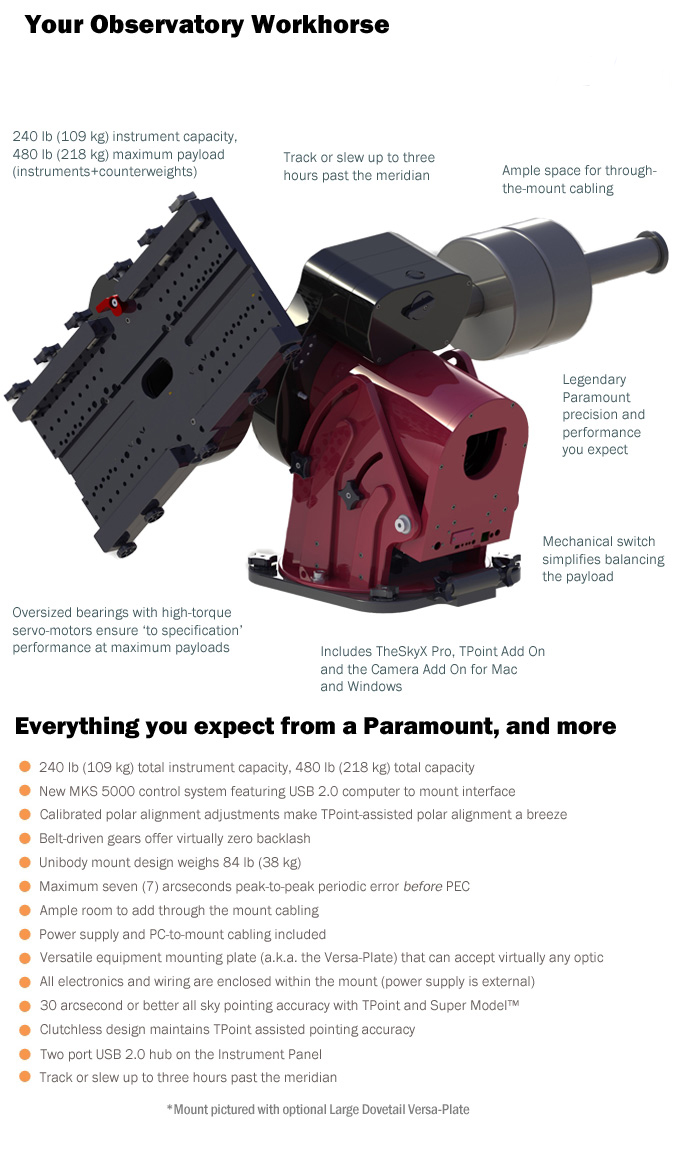
The table below compares the Paramount ME II and Paramount ME
Component |
Paramount ME II |
Paramount ME |
Control system electronics |
MKS 5000 (Fifth generation) One board includes all ports and control system electronics |
MKS 4000 (gen 4) and Adaptor Panel Two board design; Adaptor Panel includes plug in ports; MKS 4000 board contains the control system electronics.
|
Counterweight shaft |
|
|
Counterweights |
14 kg (30 lb), two included |
9 kg (20 lb), two included |
Declination bearing |
8-in (48 contact points) |
6-in (14 contact points) |
Declination gear diameter |
9.5 in. |
7.5 in. |
Declination housing |
5 in. x 0.5 in. wall 6061 aluminum tubing |
Rectangular aluminum box (6061) |
Declination shaft diameter |
3.0 in. |
2.0 in. |
Declination worm diameter |
1.0 in. |
0.75 in. |
Hours past meridian (track and slew) |
2 |
0.33 |
| Maximum slew speed | 4 degrees per second in right ascension and declination | 3.5 degrees per second in right ascension, 5 degrees per second in declination |
Motor diameter |
2.3 in. |
1.7 in. |
Motor torque |
30 in-oz |
11 in-oz |
On axis encoder (optional) |
see below |
None |
Physical hard stop position |
Configurable |
Fixed |
Power supply |
221 W (+48VDC, 4.6A max.) |
80 W |
Right ascension bearing |
8 in. (48 contact points) |
8.6 in. (18 contact points) |
Right ascension gear diameter |
11.4 in. |
11.4 in. |
Right ascension housing |
7 in. x 0.5 in. wall 6061 aluminum tubing |
Rectangular aluminum box (6061) |
Right ascension shaft diameter |
3.0 in. |
2.5 in. |
Right ascension worm diameter |
1.0 in. |
1.0 in. |
Software included |
|
Bisque Observatory Software Suite |
Through the mount cabling |
Large diameter cable conduits.Cables can be run through the mount without altering polar alignment, removing the optical tube assembly, or altering the polar alignment and no mount disassembly is required.
|
Smaller diameter cable conduits, some mount disassembly required when adding cables. |
USB ports on Instrument Panel |
Two (2) |
None |
Weight (mount body with no payload) |
38 kg (84 lb) |
31 kg (69 lb) |
Weight capacity (total payload without counterweights) |
109 kg (240 lb) |
68 kg (150 lb) |
On-Axis Encoders
On Axis Encoders Executive Summary |
|
Advantages |
|
Disadvantages
|
|
Software Bisque will offer optional on-axis encoders for the Paramount ME II; the estimated ship date at this time is second quarter 2014. The tentative (and subject to change) details about optional on-axis encoders are below:
-
Optional component for the right ascension axis and/or the declination axis.
-
Will allow all sky RMS pointing accuracies (with TPoint modeling) to five (5) arcseconds or less.
-
Periodic errors in the worm gear/main gear drive mechanics are virtually eliminated, and periodic error training is not required.
-
The axis that has the on-axis encoders always knows its mechanical orientation so that no homing or mount synchronization is necessary.
-
The Paramount ME II's right ascension and declination axes are already designed to accept on-axis encoder hardware and cabling.
-
Paramount ME IIs purchased before the on-axis encoders are available must be returned to Software Bisque for on-axis encoder installation. In other words, on-axis encoders must be installed by authorized Software Bisque personnel and cannot be installed by third-parties.
-
The estimated cost of the hardware and installation is $3,000.00 per axis.
-
Software Bisque will email all registered Paramount ME II owners when they are available.
-
On-axis encoders will not be available for the Paramount MX Robotic Telescope Mount or the earlier generation Paramount ME Robotic Telescope Mount.
While on-axis encoders have many advantages as described above, they should not be considered the "panacea" for taking long, unguided photos. Fortunately, TPoint's ProTrack (a software technology exclusive to Paramount mounts) compensates for external factors such as optical tubes that bend and differential refraction that conspire to degrade pointing and tracking accuracy and cannot be "fixed" with on-axis encoders.